More and more organizations are investing in AI and digital transformation. Yet the underlying network infrastructure is still too often overlooked. Without a reliable network, the potential of AI, real-time data, and automated production remains limited.
Artificial Intelligence, the Industrial Internet of Things (IIoT), and smart manufacturing environments are transforming the way industrial networks are designed. While bandwidth used to be the primary focus, today's priorities are availability, cybersecurity, and the integration of Operational Technology (OT) and Information Technology (IT).
Based on recent international research and our own practical experience, we have identified the five most important developments.
1. AI Places Higher Demands on Industrial Networks
AI applications generate and process enormous volumes of data. Cameras continuously transmit video streams, sensors capture thousands of measurements every second, and machines increasingly exchange real-time information.
As a result, network traffic is growing faster than ever.
A network that offered more than enough capacity just a few years ago may already be limiting further digitalization today. Scalability is therefore becoming an increasingly important design consideration.
2. Reliability Is Becoming More Important Than Speed
More bandwidth alone is no longer enough.
Modern industrial networks must excel in:
High availability
Redundancy
Low latency
Predictable real-time communication
As production processes become increasingly dependent on AI and automated decision-making, even a brief network interruption can have a significant impact on production continuity.
3. Cybersecurity Is Becoming Part of the Network Architecture
International studies show that cybersecurity remains one of the biggest challenges in implementing AI within industrial environments.
At the same time, AI is increasingly being used to detect abnormal network behavior more quickly and to improve incident analysis.
As a result, network architecture and cybersecurity are becoming increasingly interconnected. A modern industrial network must not only transport data but also contribute to securing the entire infrastructure.
4. OT and IT Are Converging
The traditional separation between office IT and production environments is rapidly disappearing.
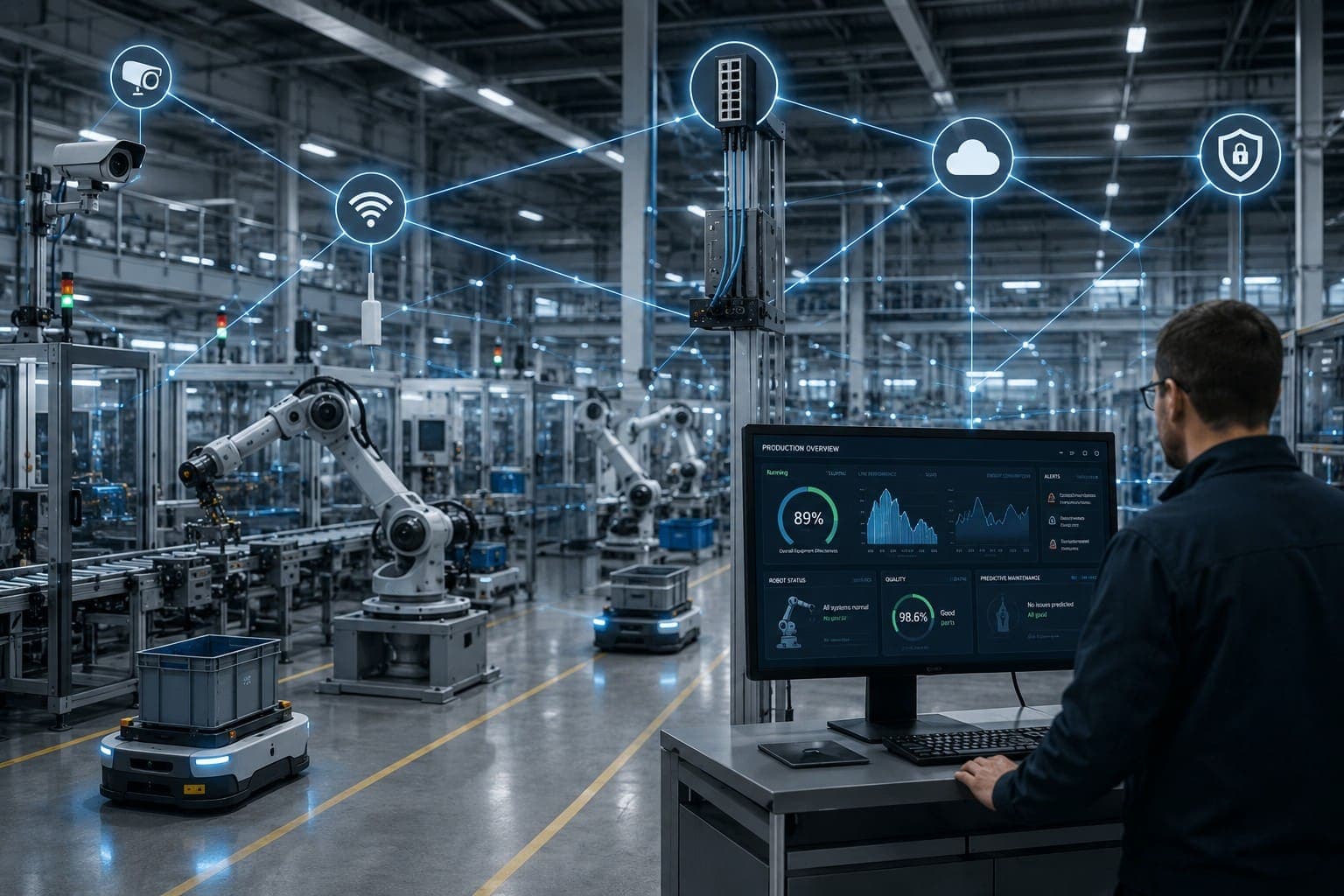
Today, production data is used for:
Dashboards
ERP systems
Cloud platforms
AI analytics
Predictive maintenance
This requires an infrastructure in which OT and IT work together securely, reliably, and efficiently without compromising production availability.
5. Future-Proof Network Design Is Becoming Essential
Technologies such as AI, edge computing, and the Industrial Internet of Things continue to evolve.
For that reason, new network projects should not only address today's requirements but also allow room for future expansion.
Making well-considered choices regarding network architecture, industrial switching, cabling, and cybersecurity helps prevent costly infrastructure upgrades only a few years down the road.
In our projects, we see organizations investing more frequently in AI, digitalization, and data-driven manufacturing. As a result, attention naturally shifts toward the quality of the underlying infrastructure.
A future-ready industrial network is not simply a collection of individual components. It is an integrated environment where connectivity, cybersecurity, and network management reinforce one another. This integrated approach ultimately determines how successfully an organization can embrace future innovations.
4net's Practical Approach
At 4net, we help organizations design, implement, and manage industrial networks that are ready for the next stage of digital transformation.
Our expertise includes:
Network architecture
Industrial switching
OT/IT integration
Cybersecurity
Industrial cabling
Lifecycle management
Together, we build infrastructures that deliver reliable performance today while remaining ready for tomorrow's growth.
Sources
This article is based on the YiR Report 2025, complemented by insights from Cisco Industry Research, Dätwyler technical documentation, and the practical experience of the 4net team.
Want to Know More?
Would you like to learn how to prepare your industrial network for AI, Industrial IoT, and further OT/IT convergence? The specialists at 4net are happy to help, from design and implementation to optimization and lifecycle management.