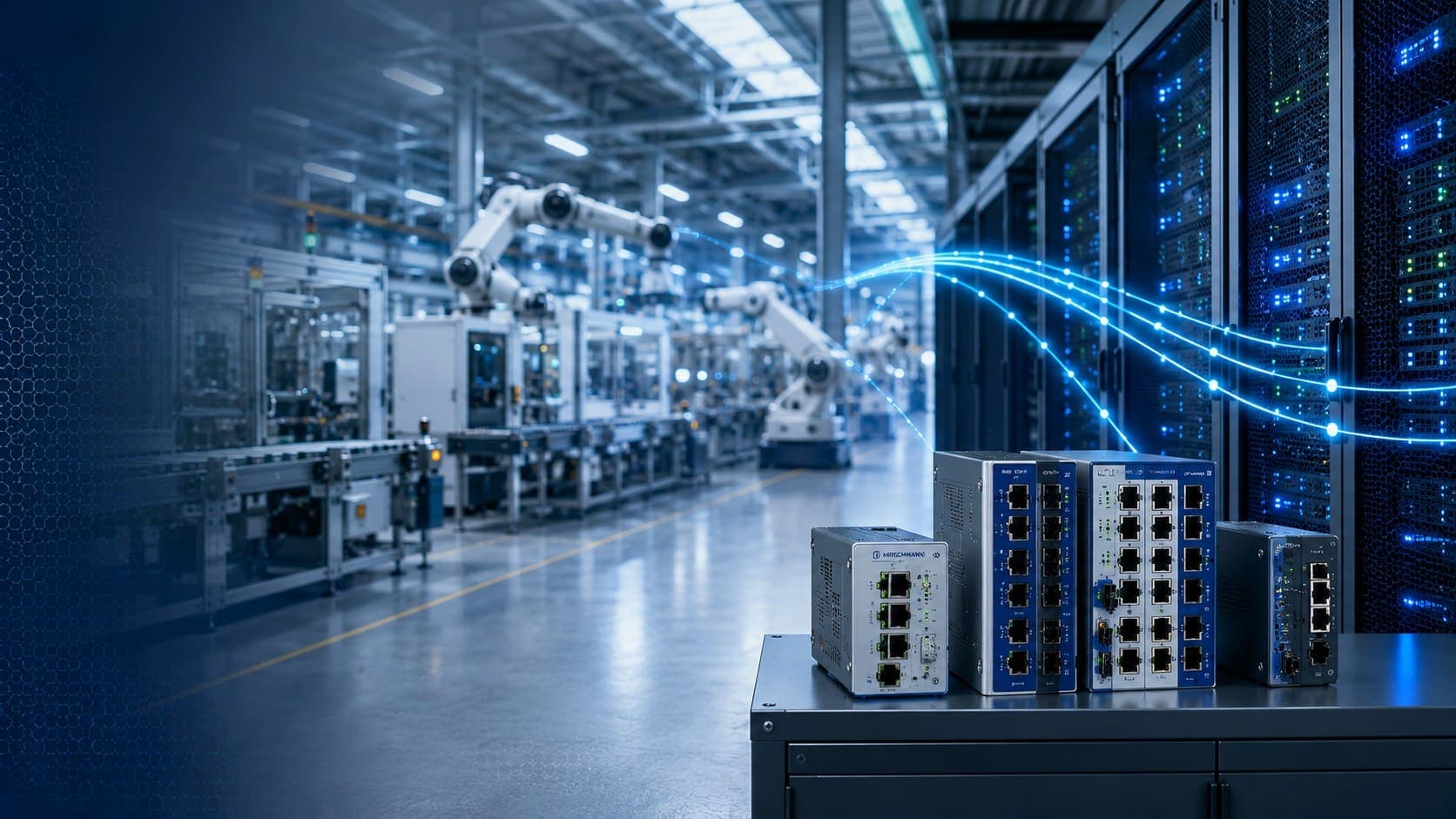

An insight from 4net
AI is rapidly finding its way into industrial environments. From predictive maintenance and camera-based quality control to real-time analysis of production data. The opportunities are considerable.
But successful industrial AI does not start with the AI model.
Machines, sensors and controllers must be able to continuously provide reliable data to the systems that process this information. If that data arrives too late, gets lost or lacks sufficient context, even the best AI solution cannot deliver reliable results.
The quality of your AI therefore starts with something much more fundamental: your industrial network.
Why AI and OT/IT convergence go hand in hand
The data AI needs is usually generated within OT: machines, sensors, controllers and production installations.
The applications that collect, analyse and process this data are often located within IT, at the edge or in the cloud. These environments therefore need to communicate with each other more intensively than ever.
This makes OT/IT convergence essential. But it is precisely at this intersection that weaknesses in existing industrial networks often become visible.
A network may be perfectly capable of keeping a production line running while still being unable to continuously provide the reliable data required for AI applications.
First, know what is connected to your network
One of the first challenges sounds surprisingly simple: knowing what is actually connected to the network.
Industrial environments often grow organically. Machines are added, installations are modified and temporary solutions sometimes remain in place much longer than originally intended.
As a result, organisations often lack a complete overview of all devices, connections and data flows.
Without that visibility, troubleshooting becomes difficult. A sensor sending irregular data may appear to be faulty, while the actual problem lies in the network connection, synchronisation or configuration.
A thorough network analysis is therefore an important first step.
Segmentation makes the network more reliable and more secure
Many older industrial networks have a relatively flat architecture. Devices and systems communicate within one large network environment.
That works well enough as long as everything is running smoothly. But as soon as a failure or cybersecurity incident occurs, the impact can be much greater than necessary.
By dividing the network into separate zones, critical processes can be better isolated from one another. Problems remain local and data flows become more predictable.
For AI, there is an additional benefit: data follows a clearer and more reliable path through the network.
An industrial environment is almost never greenfield
A modern production environment rarely consists exclusively of new equipment.
Machines with a lifespan of twenty years or more operate alongside recent systems, sensors and network components. Different protocols, suppliers and generations of technology all need to continue working together.
Replacing everything is usually unrealistic and often unnecessary.
A future-proof network architecture must therefore be able to work with the existing infrastructure. The goal is not necessarily to replace every older machine, but to connect existing and new technology securely and make the available data usable.
Technology alone does not solve OT/IT convergence
There is another factor that is easily overlooked: people.
IT focuses on standardisation, management and governance. Cybersecurity aims to reduce risk. OT primarily wants one thing: production must keep running.
All three are right.
Successful OT/IT convergence therefore requires more than the right technology. It also requires clear agreements on responsibilities, network architecture, cybersecurity and management.
4net Insight
We often see organisations enthusiastically start AI, Industrial IoT or other digitalisation projects and only afterwards look at the infrastructure on which those applications need to run.
The order should really be reversed.
Start by gaining insight into the existing network. Map assets, connections and risks. Then look at segmentation, redundancy, cybersecurity and monitoring.
Only when that foundation is reliable can the data AI depends on be reliable too.
Or, more simply: before investing in intelligence at the top of the architecture, make sure the foundation underneath is sound.
How 4net puts this into practice
At 4net, we help organisations build that foundation correctly.
This often starts with an analysis of the existing IT and OT infrastructure. From there, we look at areas including:
network architecture and segmentation;
industrial switching and routing;
OT/IT convergence;
cybersecurity;
network monitoring and visibility;
industrial cabling;
redundancy and availability.
So, not necessarily replacing everything. Instead, making sure that what is already in place can grow reliably, securely and manageably with what comes next.
Source
This article is based on Your AI Problem Is Actually a Network Problem by Fei Feng, published on 24 September 2026, and supplemented with the practical experience of the 4net team.
Want to know more?
Are you planning applications involving AI, Industrial IoT or further OT/IT convergence? Then it makes sense to first determine whether your network is ready for it.
The specialists at 4net are happy to help you map your existing infrastructure and develop a network architecture that is ready for the next step.