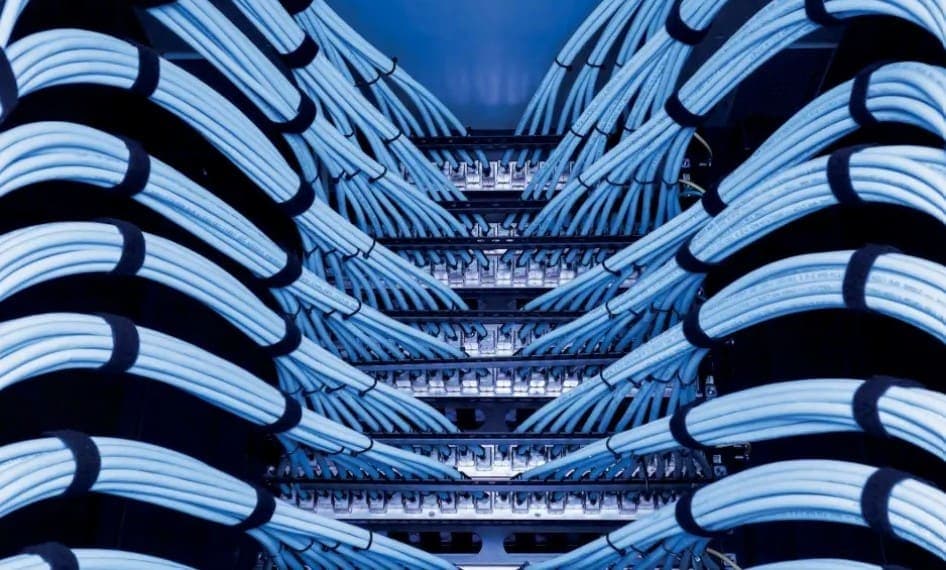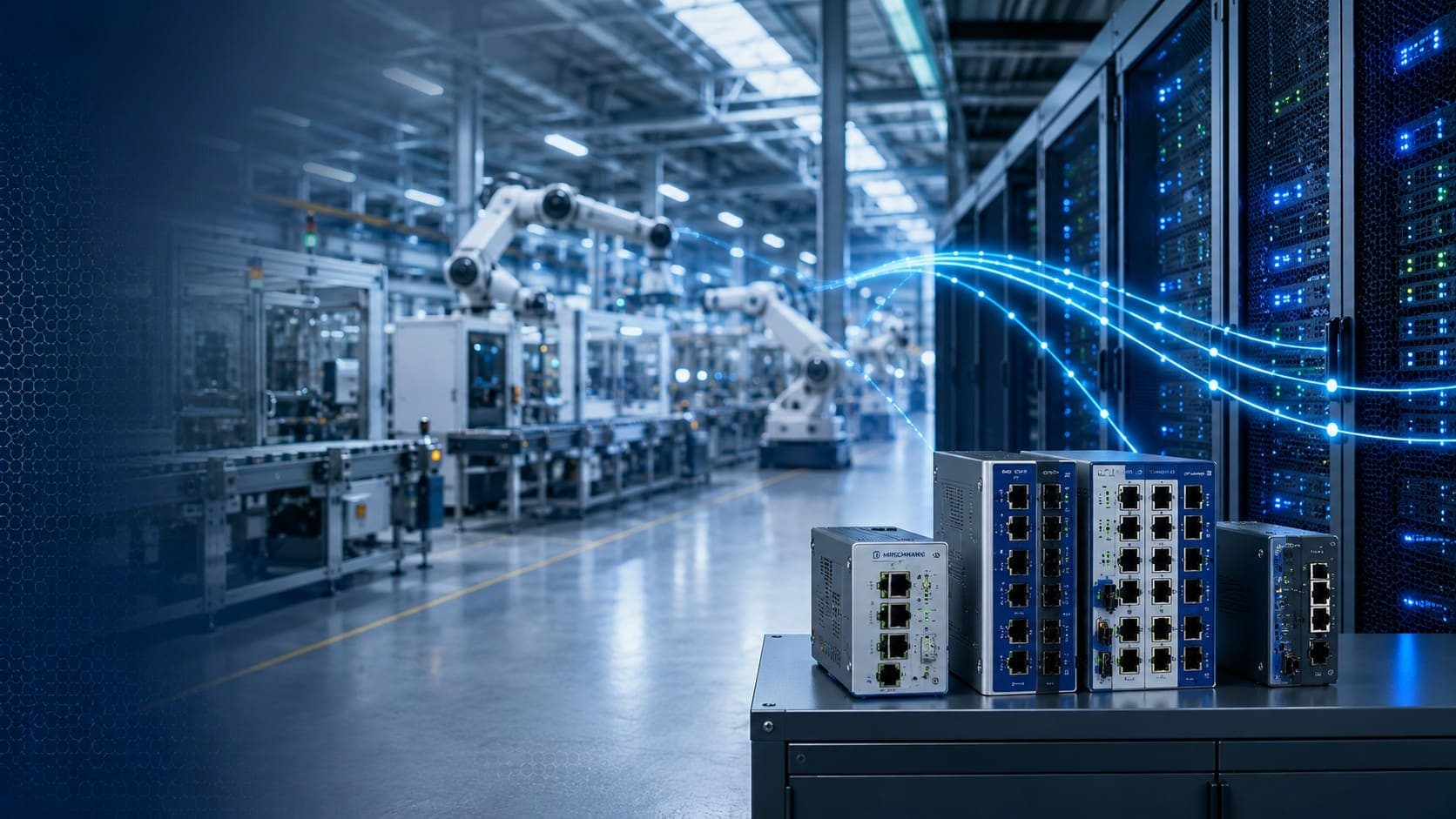
The latest developments from Dätwyler demonstrate that structured cabling is evolving from passive infrastructure into a strategic building block for industrial networks.
Digital transformation in industry is no longer just about faster networks. Production environments process ever-increasing volumes of data, machines communicate continuously with one another, and AI-driven applications place greater demands on the underlying infrastructure. This requires a cabling solution that not only meets today's requirements but is also ready for the years ahead.
Why does this matter?
More and more organisations are integrating IT and OT into a single network architecture. At the same time, the volume of data is growing exponentially due to sensors, cameras, AI applications, and edge computing.
Where network capacity used to be the primary concern, today's focus is on a combination of performance, reliability, security, and energy efficiency. A network must be able to grow for many years without requiring the complete infrastructure to be replaced.
This is precisely why the focus is shifting towards high-quality fibre optic and copper cabling, modular data centre solutions, and industrial cabling systems that can withstand demanding environments.
Key developments
Edge computing drives demand for local data centres
Not all data needs to be sent to a central data centre or the cloud anymore. In many industrial applications, local processing is essential to enable rapid decision-making.
Dätwyler addresses this need with its Smart Modular Data Centres (SMDC). These compact, pre-engineered data centre solutions are designed for rapid deployment in locations where low latency and high availability are critical.
Their modular design allows organisations to expand capacity without disrupting existing operations. With a Power Usage Effectiveness (PUE) of approximately 1.3, these solutions also offer significantly greater energy efficiency than traditional data centres.
For manufacturers, hospitals, and logistics centres, this means that critical data remains locally available, even if the connection to a central data centre is temporarily lost.
Fibre optic technology is built for the future
While copper has been the industry standard for many years, an increasing amount of network traffic is moving to fibre optics.
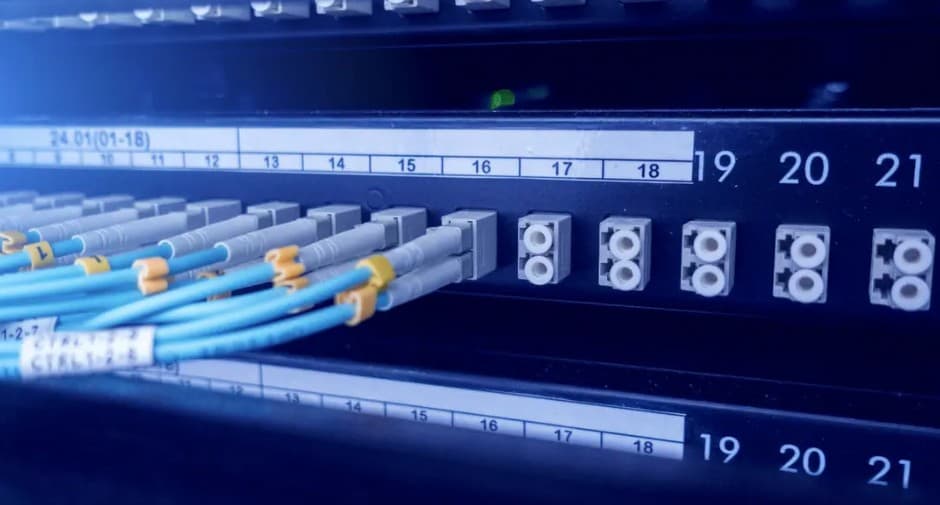
New OM5 multimode fibre supports Short Wavelength Division Multiplexing (SWDM), allowing multiple wavelengths to be transmitted simultaneously over a single fibre. This significantly increases bandwidth without requiring additional cabling.
Bend-insensitive fibres further minimise signal loss, even when cables must be routed through tight bends in compact server cabinets or industrial installations.
Universal indoor/outdoor fibre optic cables are also becoming increasingly popular. Their robust construction allows the same cable to be used both indoors and outdoors, simplifying installation while reducing the number of transition points.
Copper remains indispensable
Although fibre optic technology continues to grow in importance, copper remains an essential component of industrial networks.
Cat.6A S/FTP cabling supports 10 Gigabit Ethernet over distances of up to 100 metres and provides excellent protection against electromagnetic interference thanks to its double shielding. This is particularly important in production environments where variable frequency drives, electric motors, and heavy machinery generate significant electrical noise.
Copper technology also continues to evolve. Cat.8 enables speeds of up to 40 Gbit/s over shorter distances, while PoE++ delivers increasing amounts of power directly through the network cable to connected devices.
Cabling for demanding industrial environments
Industrial environments place very different demands on network infrastructure than office environments.
Cables are exposed to vibration, oil, chemicals, temperature fluctuations, and electromagnetic interference. As a result, there is growing demand for ruggedised cabling with high tensile strength, IP67 protection, and enhanced shielding against interference.
Safety is becoming increasingly important as well. LSZH (Low Smoke Zero Halogen) cable jackets reduce smoke generation and prevent the release of harmful gases in the event of a fire, improving safety for both personnel and equipment.
Sustainability becomes part of the infrastructure
Where sustainability once focused primarily on energy consumption, attention is now also being paid to installation lifespan and the use of recyclable materials.
Modular data centres consume less energy through more efficient cooling, while fibre optic cabling offers a considerably longer service life than traditional copper installations. The use of recyclable materials and modular expansion strategies also contributes to more sustainable future upgrades.
A modern industrial network is far more than a collection of cables. It is an infrastructure designed to support an organisation's digital ambitions well into the future.
Dätwyler's latest developments demonstrate a clear shift towards scalability, energy efficiency, and reliability. From modular edge data centres to advanced fibre optic technology and rugged industrial cabling, the foundation of a future-ready digital factory literally starts with the cabling.
Turning technology into practical solutions
At 4net, we look beyond product specifications alone.
We help organisations design complete network architectures in which fibre optics, copper cabling, industrial switches, structured cabling, and edge computing work together seamlessly. Our focus is not only on today's requirements, but also on ensuring that networks continue to meet future demands five or even ten years from now.
Because a well-designed network is not a cost. It is the foundation on which further digital transformation is built.
Source
This Insight is based on Dätwyler's latest technical innovations and product developments in the fields of Smart Modular Data Centres, fibre optic technology, structured cabling, and industrial network infrastructure.