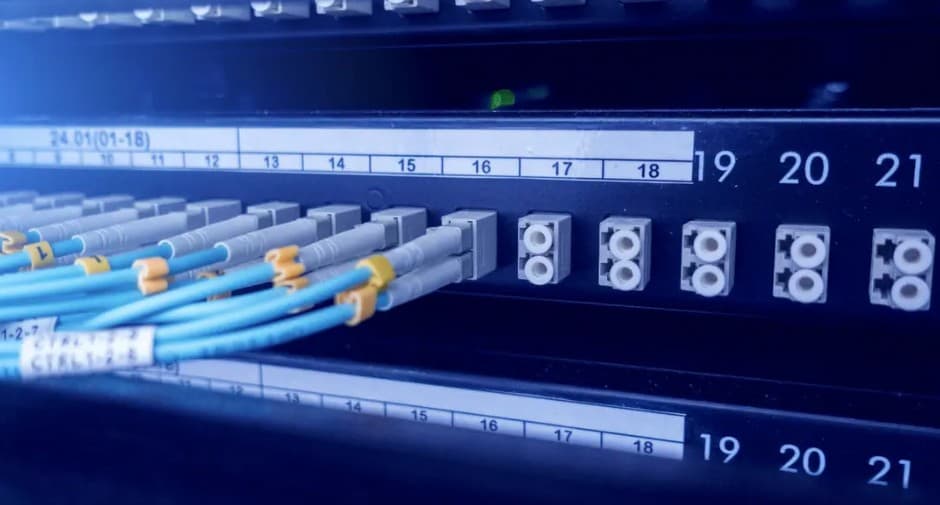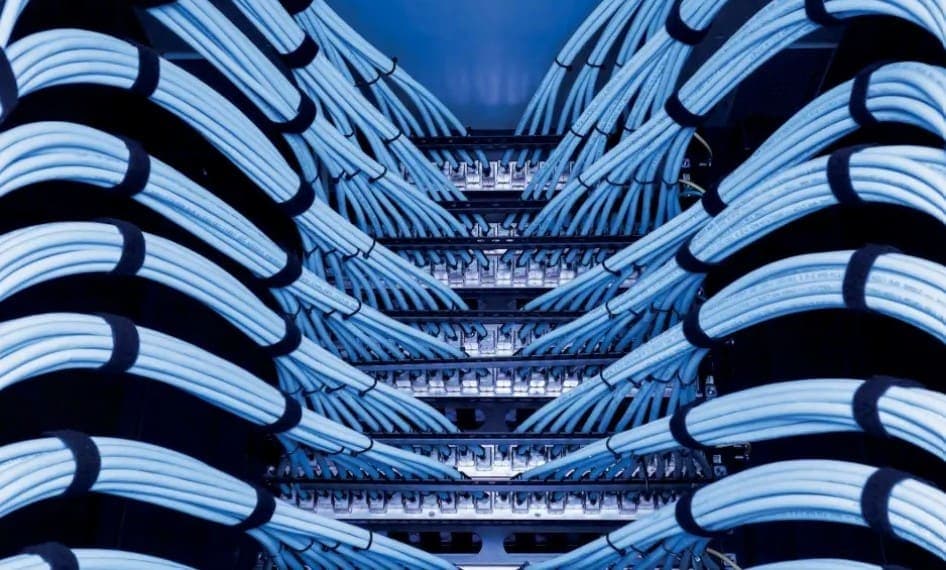
In practice, however, we see that the reliability of a network is often determined by a much more fundamental element: the passive infrastructure. Cabling, connectors, and terminations literally form the foundation on which all communication depends. When compromises are made here, faults arise that are often difficult to trace and can result in unnecessary production downtime.
When organisations invest in industrial networks, the focus is often on switches, firewalls, software, or cybersecurity. Understandably so, as these are the visible components of the infrastructure.
Why Production Environments Have Different Requirements
An Ethernet connection that performs flawlessly in an office environment faces a completely different set of challenges in an industrial installation.
Consider:
Continuous vibration
Dust and moisture
Wide temperature fluctuations
Electromagnetic interference (EMC)
Exposure to chemicals
Mechanical stress on cables
This is why industrial Ethernet components are specifically designed to withstand these demanding conditions.
A good example is the M12 connector. Unlike standard RJ45 connectors, M12 connectors feature a locking mechanism that keeps connections secure even under constant vibration. While an RJ45 connector may gradually loosen over time, an M12 connection remains mechanically stable.
The Real Cost Is Not the Cabling
When a production line comes to a standstill, nobody worries about the price of a connector.
Instead, the questions become:
How quickly can we identify the cause?
How much production is being lost?
How many technicians need to intervene?
Which deliveries will be delayed?
That is why investing in high-quality industrial cabling often pays for itself through reduced downtime, lower maintenance costs, and improved business continuity.
Rugged Means More Than a Strong Cable
An industrial Ethernet infrastructure is not judged solely by the robustness of its housing.
Equally important are:
Reliable EMC shielding
High mechanical durability
Stable long-term performance
Ease of installation
Simple maintenance
Compatibility with industrial communication protocols
These are the characteristics that ensure a network continues to operate reliably for many years, even under harsh operating conditions.
Ready for Tomorrow's Networks
Industrial networks are evolving rapidly. Machines increasingly communicate directly with one another, sensors continuously generate data, and cameras produce ever-growing streams of information.
Technologies such as Single Pair Ethernet (SPE) are also gaining momentum. SPE enables intelligent sensors and field devices to connect directly to the Ethernet network, making it a key building block for the Industrial Internet of Things (IIoT) and ongoing digital transformation.
The choices made today regarding cabling and connectivity will therefore determine how easily future network expansions can be implemented.
Across our projects, we see organisations increasingly investing in high-performance switches and cybersecurity, while the passive infrastructure often receives less attention. Yet it is precisely this infrastructure that forms the foundation of a reliable network.
A well-designed cabling infrastructure prevents failures, reduces maintenance time, and extends the lifespan of the entire network.
Turning Technology into Practical Solutions
At 4net, we support organisations not only in selecting active network components but also in designing future-proof industrial network infrastructures.
Our expertise includes advising on:
Industrial cabling
Connectors and connection technologies
Copper and fibre optic solutions
Testing and certification
Future-ready network architectures
Because, ultimately, a network is never stronger than its weakest link.
Source
This article is based on Dätwyler's technical documentation, complemented by the practical experience of the 4net team and international best practices for industrial Ethernet infrastructures.
Want to Learn More?
Would you like to know which industrial Ethernet solutions are best suited to your production environment? The specialists at 4net are happy to help, from network design and component selection through to implementation, validation, and ongoing management.